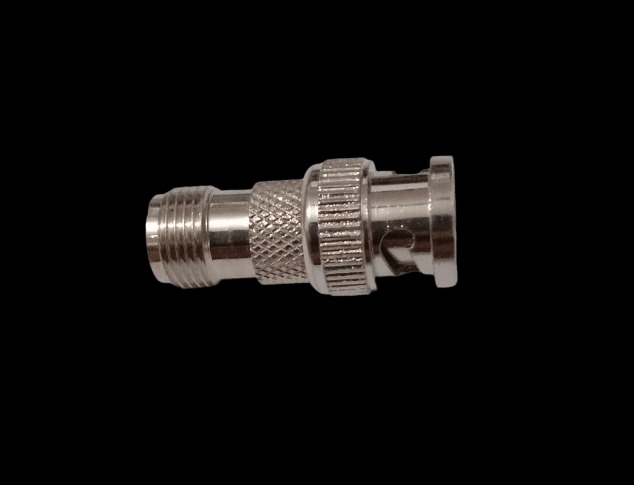
Gender: Male (with a central pin and surrounding shield)
TNC Female:
Connector Type: Threaded Neill-Concelman (TNC)
Gender: Female (with a central socket and surrounding shield)
Frequency Range:
Up to 3 GHz: The adapter is designed to work efficiently at frequencies up to 3 gigahertz, ensuring reliable signal transmission and minimal signal degradation.
Impedance:
Typically 50 Ohms:
BNC Connectors: Often 50 ohms, used for RF applications.
TNC Connectors: Usually 50 ohms as well. Ensuring that the impedance of the adapter matches your equipment is crucial for preventing signal reflection and loss.
Mechanical Construction:
Material: Typically constructed from durable metals such as brass or stainless steel, with plating options like gold or nickel to enhance conductivity and resist corrosion.
Design: Designed to provide a secure and reliable connection between BNC Male and TNC Female connectors, maintaining signal integrity.
Applications:
RF Testing: Connecting RF equipment or devices with BNC and TNC connectors in test setups.
Communication Systems: Bridging connections between devices or cables with different RF connectors.
Antenna Systems: Connecting antennas or other components with BNC and TNC interfaces.
General RF Applications: Useful where a transition between BNC and TNC connectors is needed.
Typical Features:
Low Signal Loss: Designed to minimize signal degradation and ensure efficient signal transfer between different connector types.
Durability: Built to handle frequent use and provide reliable performance over time.
The BNC(M) to TNC(F) adaptor is designed for RF and signal transmission applications, supporting frequencies up to 3GHz. It features a BNC male connector on one end and a TNC female connector on the other, allowing for easy interfacing between different connector types. This adaptor is ideal for use in telecommunications, broadcast systems, and test equipment, providing reliable signal transfer with minimal insertion loss. Its durable construction ensures long-term performance in both laboratory and field environments. |
Weight
0.1 kg
Reviews
There are no reviews yet.
Be the first to review “BNC(M) TO TNC(F) ADAPTOR 3GHZ” Cancel reply



Reviews
There are no reviews yet.