

Dual-Band Coverage
-
Low-band (824-960 MHz): This range covers key cellular bands used in many regions for 2G/3G/4G. It offers better penetration through walls and obstacles, making it ideal for indoor environments where signal strength may be weak.
-
Mid-band (1710-2180 MHz): Supports higher-frequency cellular signals including 3G/4G LTE bands. These frequencies allow higher data throughput and capacity, beneficial for mobile broadband services.
➡️ Dual band operation allows the antenna to serve multiple cellular services simultaneously without needing separate antennas for each band.
📡 Omnidirectional Radiation Pattern
-
This antenna radiates and receives signals in a 360-degree horizontal pattern, which means it distributes and captures RF energy equally in all directions around the unit.
-
This is ideal for central ceiling installation in offices, homes, malls, or public buildings to ensure broad, uniform indoor coverage. Having an omni pattern helps reduce dead spots in a coverage area.
📈 Gain Specifications (2.5/4.5 dBi)
-
Gain is a measure of how effectively the antenna converts input power into radio waves in a specific direction compared to a reference antenna.
-
2.5 dBi (Low band) and 4.5 dBi (Mid band) indicate this antenna provides moderate gain — enough to improve signal strength and reach while maintaining a wide, nearly uniform coverage pattern across the room.
-
Higher gain values mean better signal strength at greater distances, but with a narrower vertical beam, which is not desirable for ceiling installations where coverage up/down is also needed.
🔌 Design & Installation
-
Typically features a low-profile housing that blends into ceiling interiors, making it unobtrusive and aesthetically suitable for office spaces or commercial environments.
-
The antenna is designed to be mounted on or recessed into ceilings, such that RF energy is radiated downward and outward to cover the space below.
-
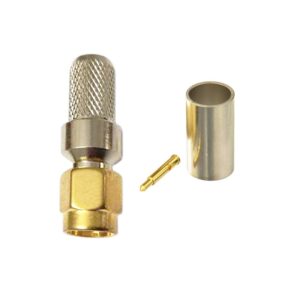
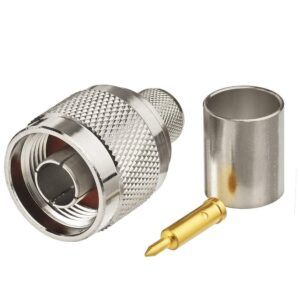
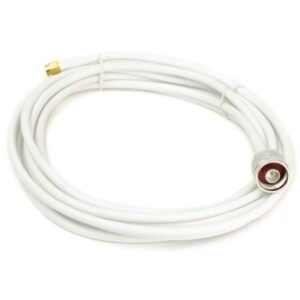
Standard 50 Ω coaxial connection ensures compatibility with most RF equipment, repeaters, DAS (Distributed Antenna Systems), signal boosters, or cellular modems.
⚙️ Technical Performance
-
Impedance: 50 Ω (standard for RF systems).
-
VSWR: Often ≤2.5:1 across each band, indicating good matching and minimal signal reflection back to the transmitter.
-
Polarization: Typically vertical, matching the majority of cellular base station signals.
-
Radiation pattern: Omnidirectional in azimuth (horizontal plane) for uniform indoor signal coverage.
-
This type of antenna supports indoor distributed antenna systems (DAS) and can be used in buildings needing enhanced cellular signal distribution from a central point.
🏢 Applications
-
Indoor signal boosting / cellular repeaters and boosters in homes, buildings, offices.
-
Distributed Antenna Systems (DAS) in corporate or commercial spaces.
-
Connectivity enhancement for wireless routers, gateways, LTE modems, IoT devices that operate across dual cellular bands.
-
Improving voice and data service quality where external signal strength is weak or inconsistent.
Reviews
There are no reviews yet.