
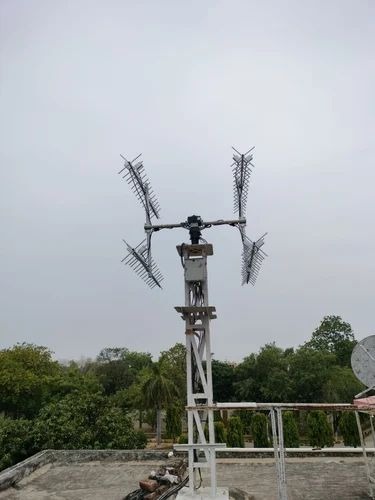
-
Operating Frequency: 403 MHz to 520 MHz
This range covers a broad portion of UHF, which includes many industrial, commercial, public safety, and communication radio systems. The antenna is typically factory-tuned to this band so that it maintains good impedance and radiation performance across the entire range. -
Nominal Gain: ~6 dBi
Gain describes how well the antenna concentrates energy in a given direction compared to an isotropic source. A 6 dBi gain means the antenna moderately focuses energy forward, increasing effective range and signal strength in the intended direction without becoming overly directional (narrow beam). Lower gain compared with 9–12 dBi models often results in wider beamwidth, easier aiming, and a good balance between coverage and directivity.
🧱 Construction & Design
-
Yagi-Uda Structure:
The antenna consists of a driven element, reflector, and multiple director elements mounted along a central boom. The driven element is connected to the feed line and actively radiates/receives RF energy, while the reflector and directors are parasitic elements that reinforce forward radiation and suppress backward lobes.Boom & Elements:
Usually made from lightweight aluminum alloy for strength, corrosion resistance, and low weight. -
Connector:
Standard RF connector such as N-female or SO-239, matching typical 50 Ω coaxial feed lines used in radio systems. -
Polarization:
Can typically be mounted in either vertical or horizontal orientation, depending on the system needs.
Reviews
There are no reviews yet.